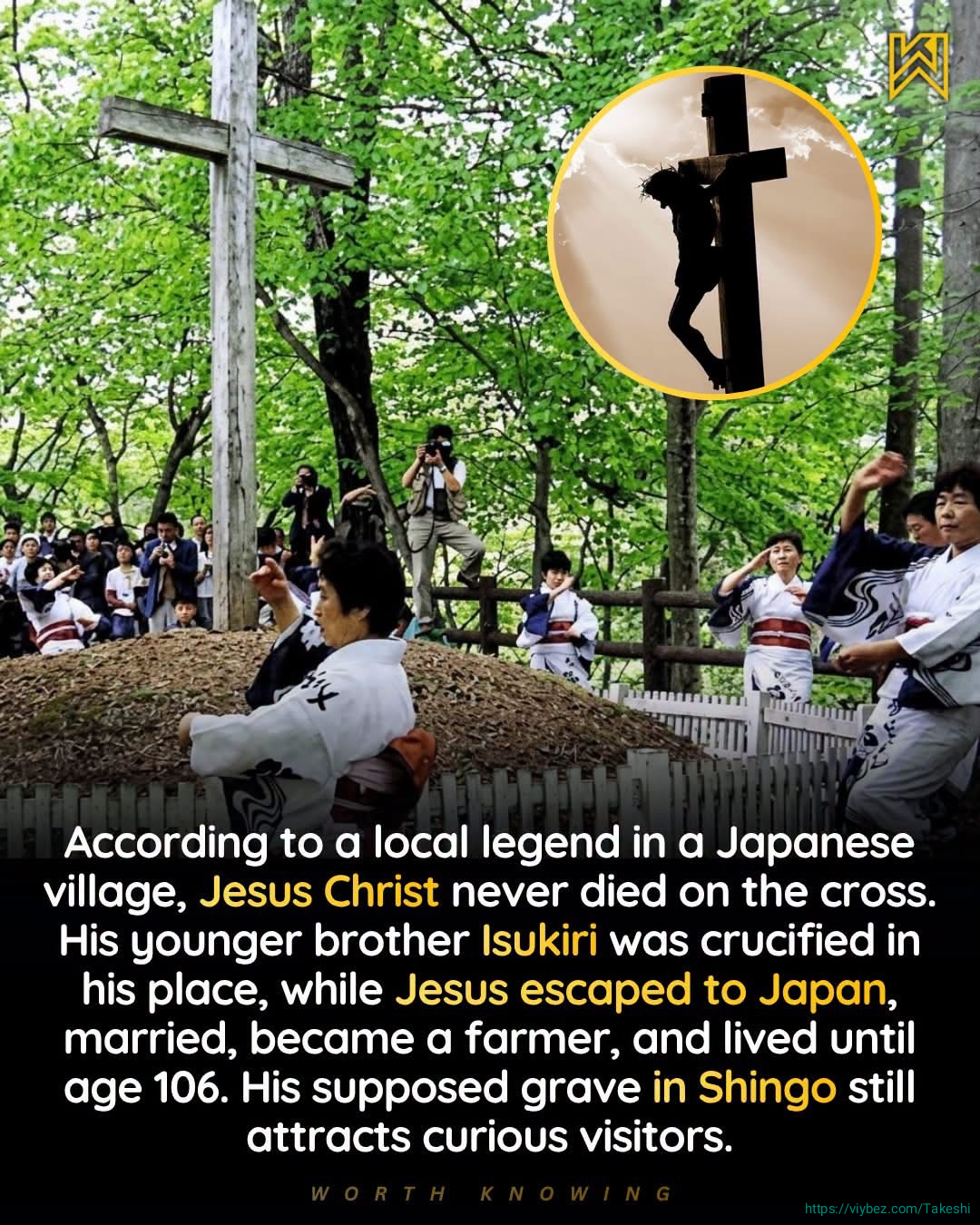

The village is Shingo, in Aomori Prefecture, in the far north of Japan’s main island. It is a quiet place of rice fields and cedar forests. It is also home to one of the strangest local legends in the world.
According to the story told there, Jesus Christ did not d!e in Jerusalem. His younger brother, Isukiri, took his place on the cross. Jesus escaped. He traveled across Asia, crossed the sea, and arrived in Japan. He settled in Shingo. He married a local woman. He became a rice farmer. He lived to be 106 years old.
The legend says his grave is on a small hill behind the village. Next to it is a second grave, said to hold the ears and a lock of hair of Isukiri, brought to Japan by Jesus as a relic.
The site is marked by a wooden cross and a sign. It is called the “Grave of Christ.” Visitors come from across Japan and beyond. Some leave coins. Some take photos. Some just stand and look at the two mounds of earth.
The legend was first written down in the 1930s by a local priest named Kiyomaro Takenouchi. He claimed to have found ancient documents that recorded the story. The documents were never authenticated. But the story took root. It became part of the village’s identity.
Shingo is not a major tourist destination. It is not on the standard itinerary. But the grave is real, the sign is real, and the story is told by the people who live there. Whether it is history or folklore, it has become a part of the place.
What do you think—does a legend like this belong to the people who tell it, or to the rest of us who hear it?