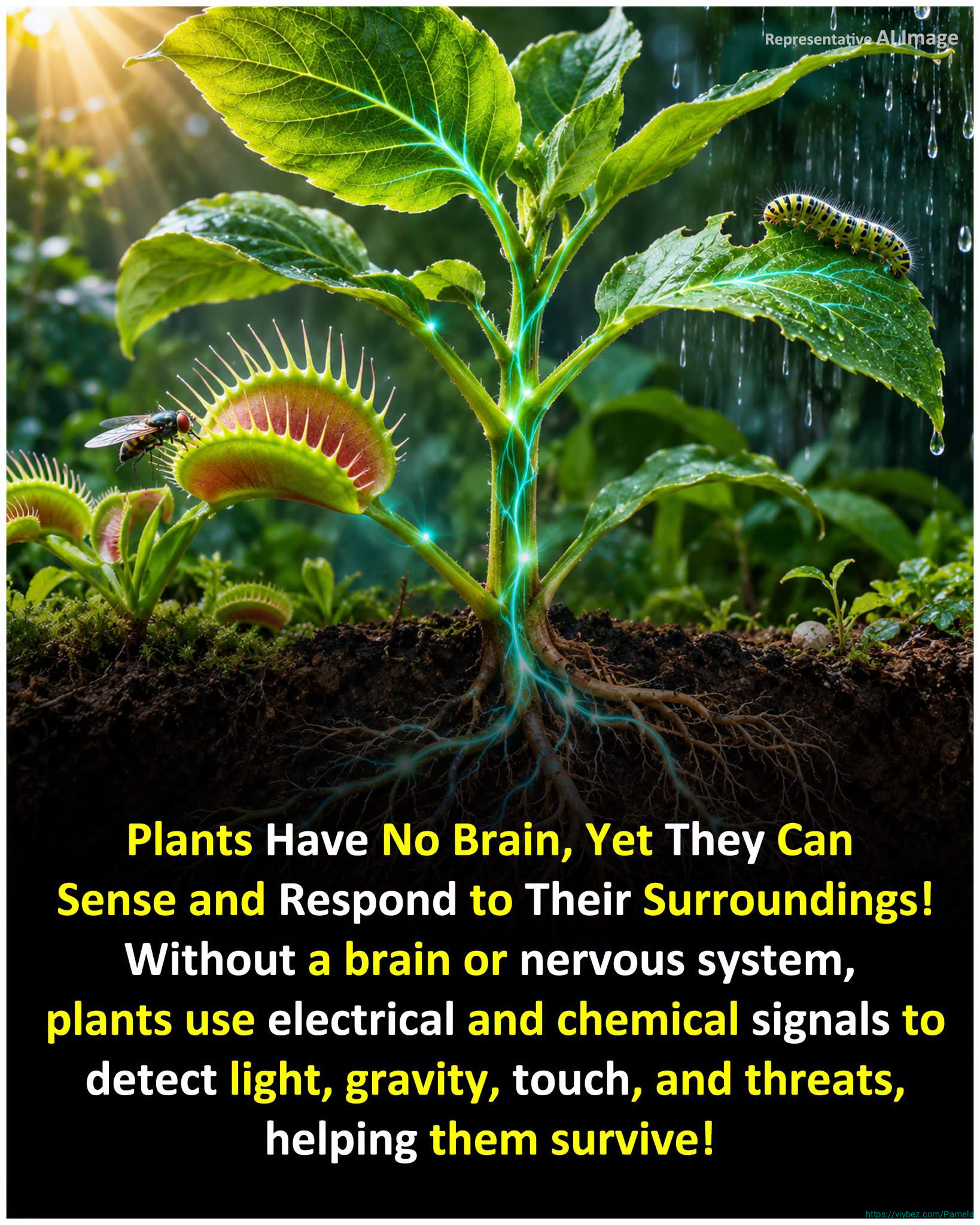

Plants Have No Brain, Yet They Can Sense and Respond to Their Surroundings! Plants may seem quiet and motionless, but they have extraordinary systems for detecting changes in the world around them!
Unlike humans and animals, plants have no brain, neurons, or nervous system. Instead, they use electrical signals, chemical messengers, and specialized cells to coordinate their responses.
Their roots can detect gravity, their leaves respond to sunlight, and some plants activate defensive chemicals when insects attack.
One fascinating example is the Venus flytrap. When an insect triggers its sensitive hairs, electrical signals help the plant snap its trap shut.
Even more surprisingly, these signals can travel between different parts of a plant, allowing it to coordinate responses to environmental threats.
This doesn't mean plants think like humans. It shows that sophisticated biological information processing can happen without a brain!
Sources - Current Opinion in Plant Biology (2026), Learning & Behavior (2026), PLOS Biology (2020).
Note: The image used in this post was created using AI for educational purposes only.