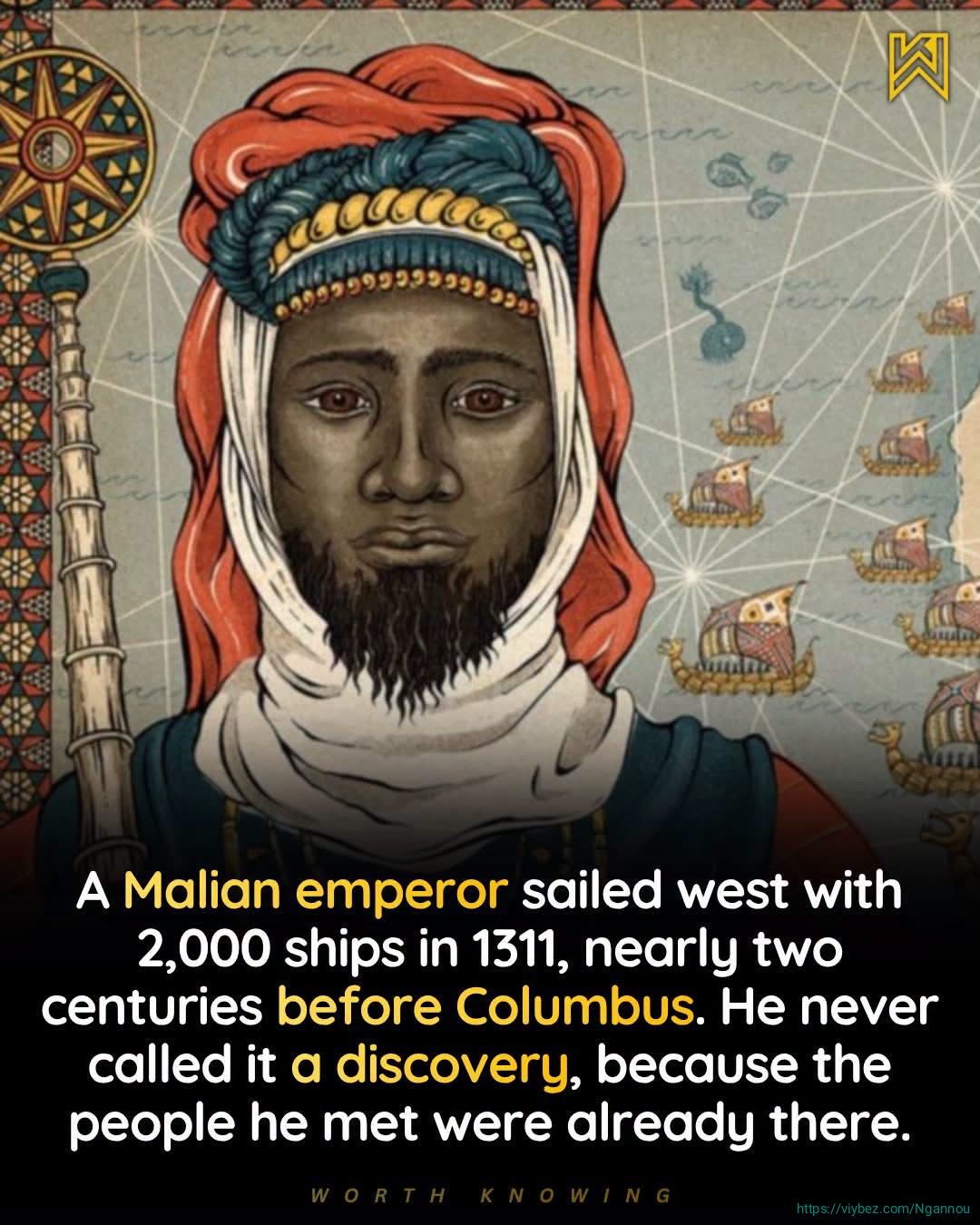

The story comes from Mansa Musa, the famous king of Mali, during his pilgrimage to Mecca in 1324. He told an Egyptian official that his predecessor had refused to believe the Atlantic Ocean had no end. The king outfitted 200 ships, filled them with men, gold, water, and provisions, and ordered the captain not to return until he reached the far shore.
Only one ship came back. The captain reported a violent current in the open sea—a "river" within the ocean—that swallowed the rest of the fleet. The king did not believe him. He prepared 2,000 more ships, took 1,000 for himself and his men, and loaded the other 1,000 with supplies. He handed the throne to Musa and sailed west. No one ever saw him again.
That is the historical core, recorded by the Arab historian al-Umari. The rest is a story that refuses to die: that Abubakari II crossed the Atlantic and landed on the coast of Brazil, near modern Recife. Some researchers point to Columbus's own writings, where he reported finding Black traders already present in the Americas, and to gold-tipped spears that chemical analysis suggests came from West Africa.
The claim that he "never claimed to discover America because he knew it was already there" is not a historical quote. It is a modern philosophical framing. But it captures something true about the voyage: if Abubakari reached the Americas, he did not arrive in an empty land. He arrived in a world that already had its own people, its own cities, and its own history.
Does a story like this mean more as history, or as a reminder that "discovery" was never the right word?