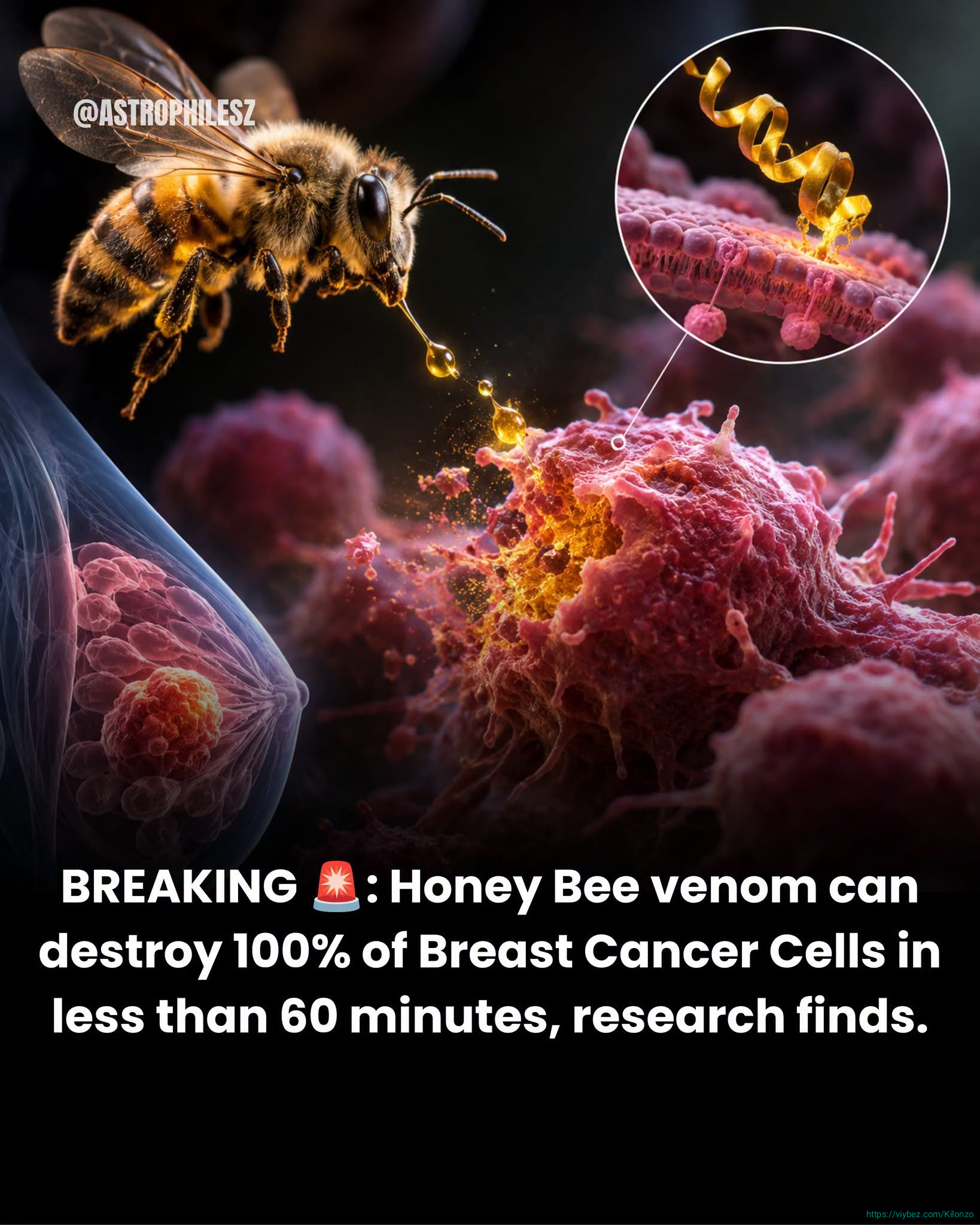

Scientists have discovered that a natural compound found in honeybee venom can destroy certain aggressive breast cancer cells in laboratory experiments, opening a promising direction for cancer research.
Researchers at the Harry Perkins Institute of Medical Research and the University of Western Australia investigated how honeybee venom affects different types of breast cancer, particularly triple-negative and HER2-enriched breast cancer.
Their experiments revealed that honeybee venom could rapidly destroy cancer cells under controlled laboratory conditions. At specific concentrations, the venom killed 100% of the tested cancer cells within approximately 60 minutes.
The key ingredient is melittin, a small peptide that makes up a major component of honeybee venom. Scientists discovered that melittin can disrupt cancer cell membranes, creating openings that damage the cells and eventually cause them to die.
Researchers also found that melittin interfered with important signaling pathways that cancer cells use to grow and reproduce.
Interestingly, the team demonstrated that a synthetic version of melittin could reproduce the anticancer effects of the naturally occurring compound.
In experiments involving mice, combining melittin with the chemotherapy drug docetaxel improved the treatment’s ability to suppress tumor growth.
This finding is particularly relevant for triple-negative breast cancer, an aggressive form of the disease that lacks several common molecular targets used in other breast cancer treatments.
However, these results come from laboratory and animal experiments. Scientists have not established that honeybee venom can safely or effectively treat breast cancer in humans.
Melittin can also damage healthy cells, so researchers must develop methods to deliver it selectively to tumors while minimizing harmful effects.
The discovery highlights how naturally occurring molecules can provide valuable starting points for developing future cancer treatments.
Source: npj Precision Oncology; Harry Perkins Institute of Medical Research; University of Western Australia.