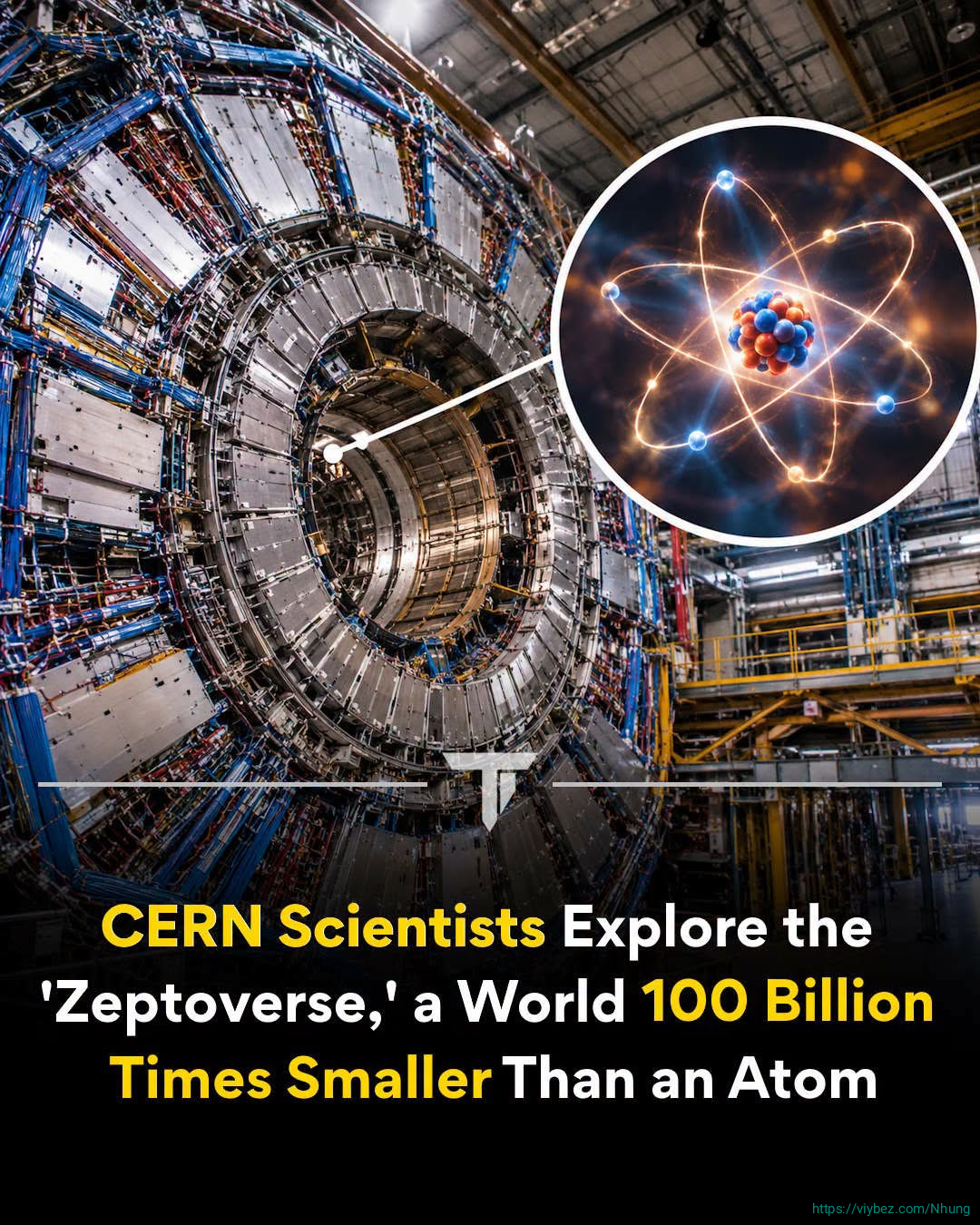

Scientists at CERN have found new evidence of an extremely rare particle process after more than 40 years of searching. The finding could help them explore what physicists call the "zeptoverse".
The research comes from the LHCb experiment at the Large Hadron Collider near Geneva, Switzerland. Scientists found evidence of a B⁰ meson decaying into two particles called muons, which are heavier than electrons.
This process is extremely rare. Scientists estimate it happens only once in every 10 billion beauty-particle decays.
Researchers have been searching for this process since 1984. The latest results combine data from 2024 and 2025 with earlier data collected between 2011 and 2018.
The results reached 3.2 sigma. This is evidence of the process, but it is below the 5-sigma level normally needed to confirm a discovery in particle physics.
The research also helps scientists study distances around 100 zeptometres, an extremely tiny scale described as the "zeptoverse".
The results agree with current physics theories. No new particle or force has been discovered, but the findings could help scientists look for new physics.
CERN announced the results on November 3, 2026.
Source: CERN, LHCb Collaboration, University of Cambridge.